 Architecture,
design and urbanism
Architecture,
design and urbanism
|
|
Architecture,
design and urbanism |
|
|
|
|
CHINA: A Leading Voice from the Global South on the Challenges of Sustainable Developments - An Interview with Douglas DreherEnero 1, 2009 | LANDSCAPE DESIGN MagazineTomado de: LANDSCAPE DESIGN Magazine
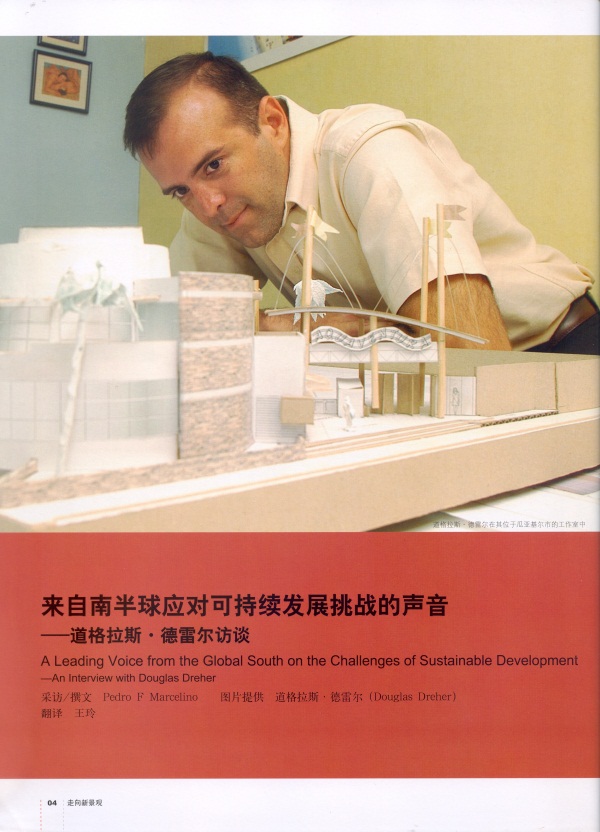
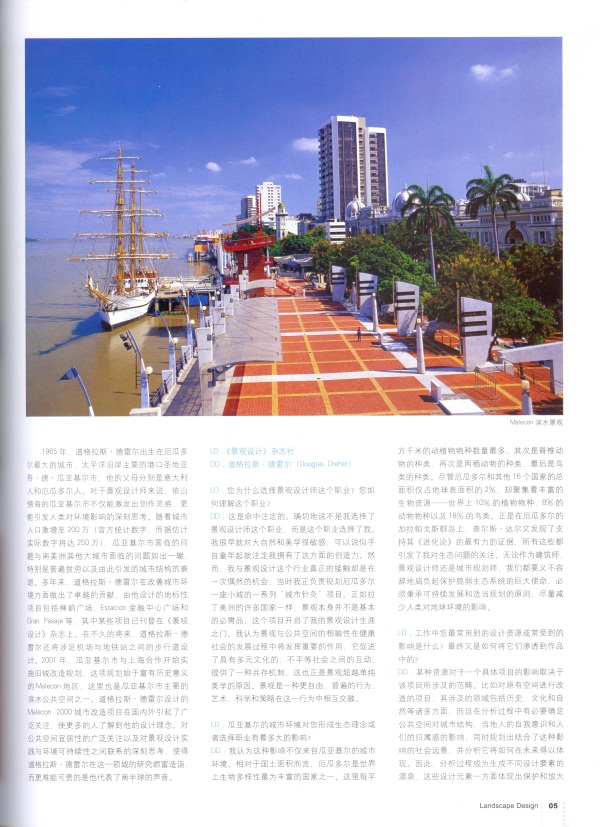
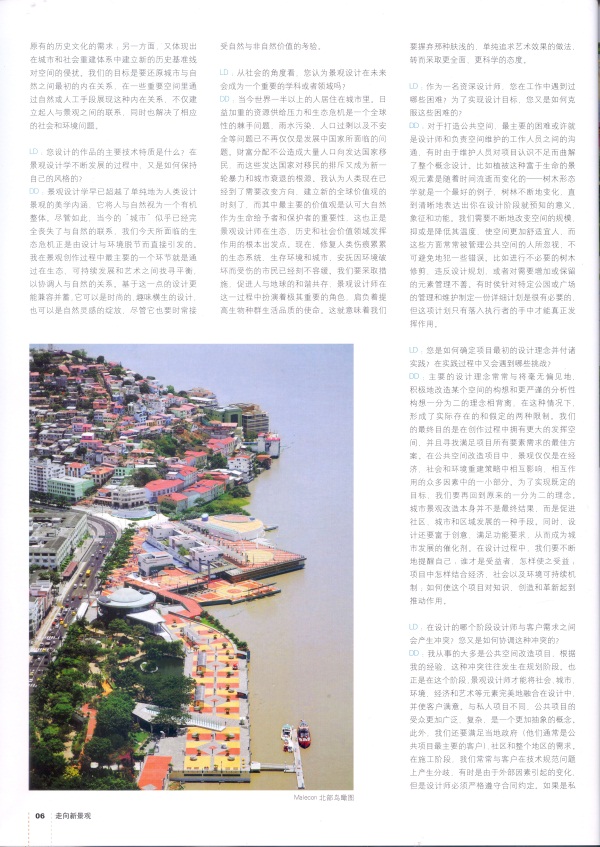
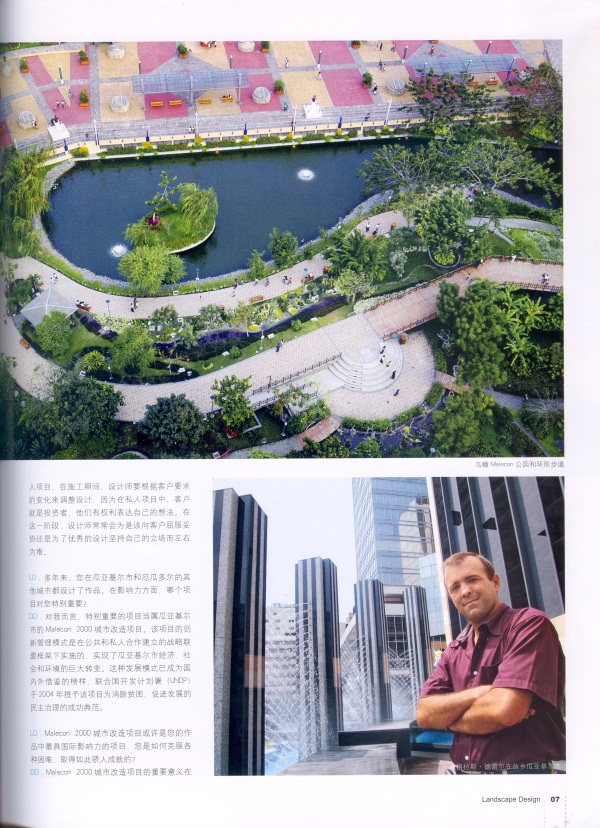
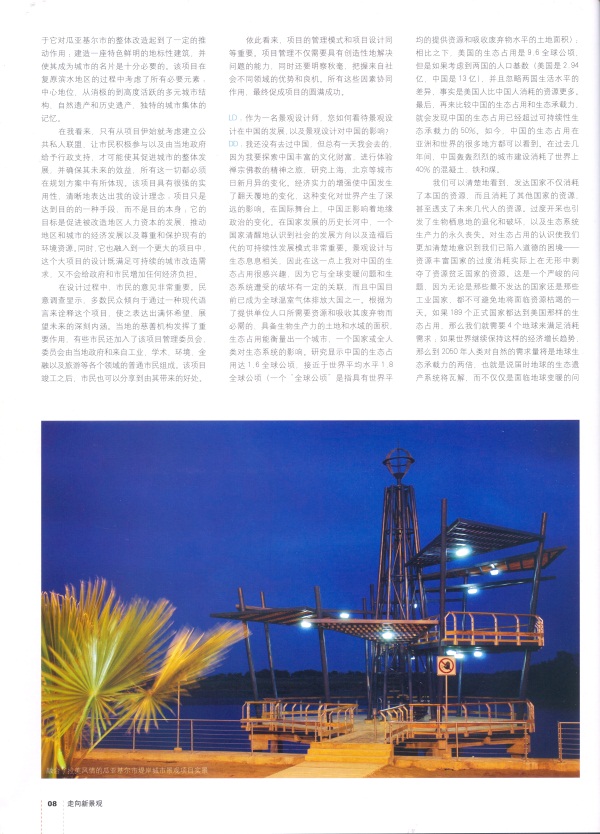
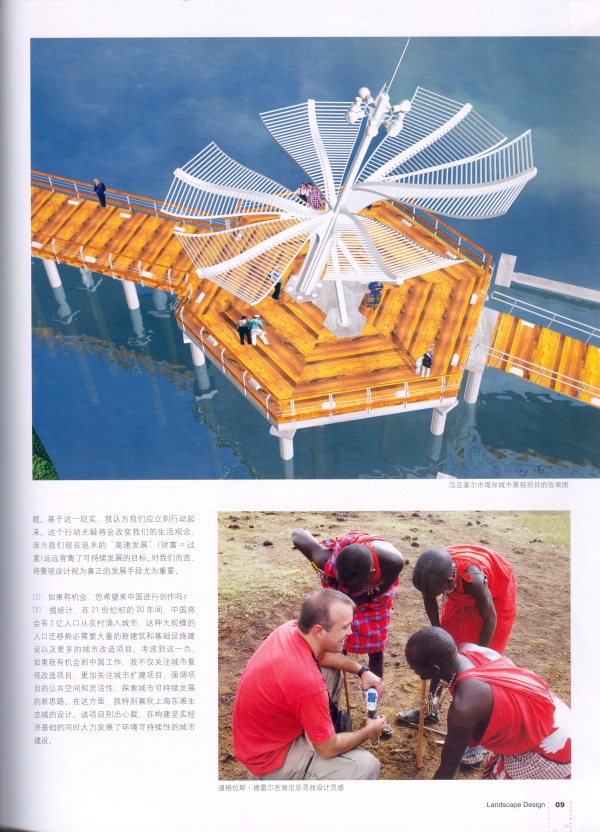
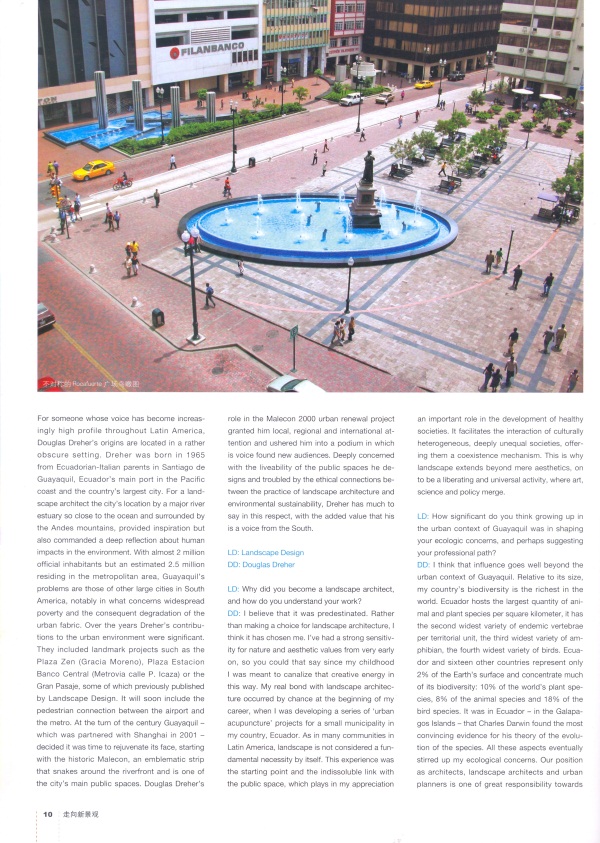
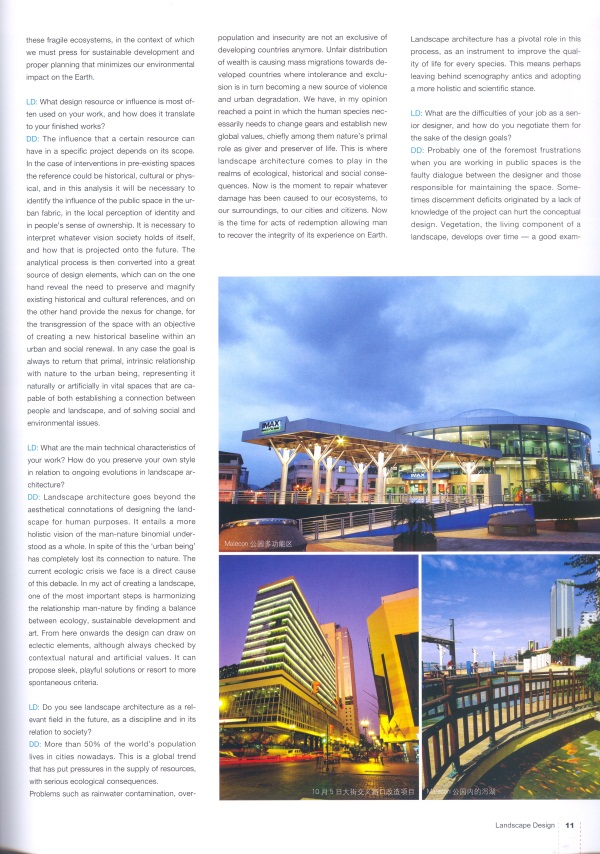
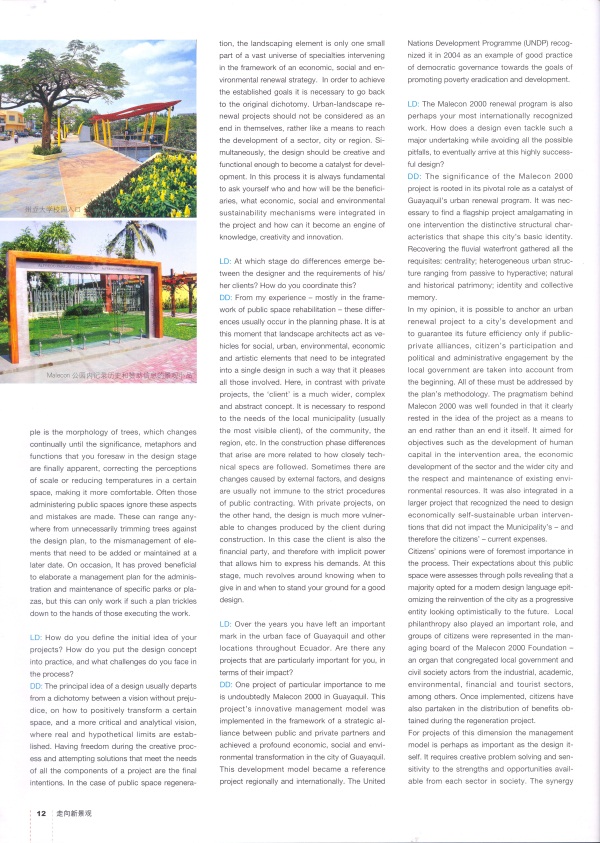
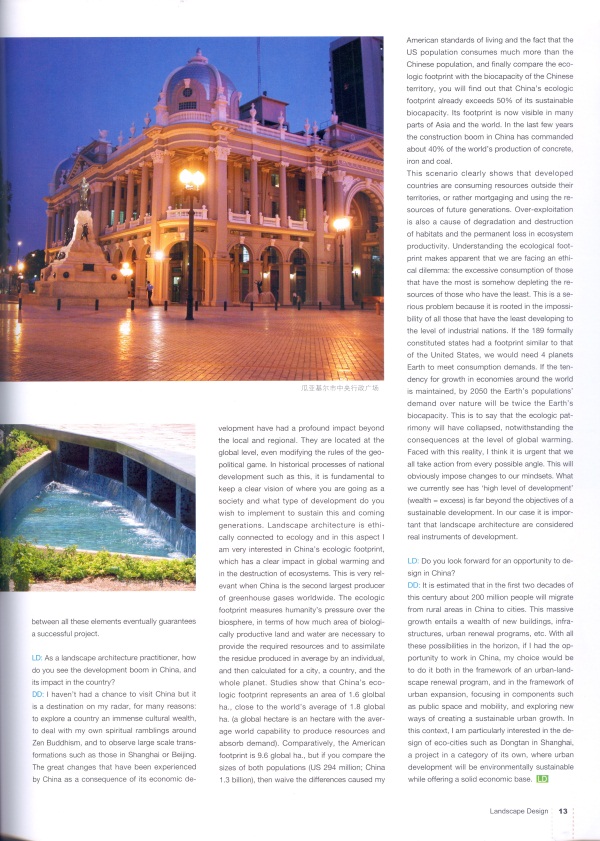
For someone whose voice has become increasingly high profile throughout Latin America, Douglas Dreher´s origins are located in a rather obscure setting. Dreher was born in 1965 from Ecuadorian-ltalian parents in Santiago de Guayaquil, Ecuador´s main port in the Pacific coast and the country´s largest city. For a landscape architect the city´s location by a major river estuary so close to the ocean and surrounded by the Andes mountains, provided inspiration but also commanded a deep reflection about human impacts in the environment. With almost 2 million official inhabitants but an estimated 2.5 million residing in the metropolitan area, Guayaquil´s problems are those of other large cities in South America, notably in what concerns widespread poverty and the consequent degradation of the urban fabric. Over the years Dreher´s contributions to the urban environment were significant. They included landmark projects such as the Plaza Zen (Gracia Moreno), Plaza Estacion Banco Central (Metrovia salle P. lcaza) or the Gran Pasaje, some of which previously published by Landscape Design. It will soon include the pedestrian connection between the airport and the metro. At the turn of the center Guayaquil - which was partnered with Shanghai in 2001 - decided it was time to rejuvenate its face, starting with the historic Malecon, an emblematic strip that snakes around the riverfront and is one of the city´s main public spaces. Douglas Dreher´s role in the Malecon 2000 urban renewal project granted him local, regional and international attention and ushered him into a podium in which is voice found new audiences. Deeply concerned with the liveability of the public spaces he designs and troubled by the ethical connections between the practice of landscape architecture and environmental sustainability, Dreher has much to say in this respect, with the added value that his is a voice from the South. LD: Landscape Design LD: Why did you become a landscape architect, and how do you understand your work? DD: I believe that it was predestinated. Rather than making a choice for landscape architecture, I think it has chosen me. I´ve had a strong sensitivity for nature and aesthetic values from very early on, so you could that say since my childhood I was meant to canalize that creative energy in this way. My real bond with landscape architecture occurred by chance at the beginning of my career, when I was developing a series of ´urban acupuncture´ projects for a small municipality in my country, Ecuador. As in many communities in Latin America, landscape is not considered a fundamental necessity by itself. This experience was the starting point and the indissoluble link with the public space, which plays in my appreciation an important role in the development of healthy societies. It facilitates the interaction of culturally heterogeneous, deeply unequal societies, offering them a coexistence mechanism. This is why landscape extends beyond mere aesthetics, on to be a liberating and universal activity, where art, science and policy merge. LD: How significant do you think growing up in the urban context of Guayaquil was in shaping your ecologic concerns, and perhaps suggesting your professional path? DD: I think that influence goes well beyond the urban context of Guayaquil. Relative to its size, my country´s biodiversity is the richest in the world. Ecuador hosts the largest quantity of animal and plant species per square kilometer, it has the second widest variety of endemic vertebrae per territorial unit, the third widest variety of amphibian, the fourth widest variety of birds. Ecuador and sixteen other countries represent only 2% of the Earth´s surface and concentrate much of its biodiversity: 10% of the world´s plant species, 8% of the animal species and 18% of the bird species. It was in Ecuador - in the Galapagos Islands - that Charles Darwin found the most convincing evidence for his theory of the evolution of the species. All these aspects eventually stirred up my ecological concerns. Our position as architects, landscape architects and urban planners is one of great responsibility towards these fragile ecosystems, in the context of which we must press for sustainable development and proper planning that minimizes our environmental impact on the Earth. LD: What design resource or influence is most of- ten used on your work, and how does it translate to your finished works? DD: The influence that a certain resource can have in a specific project depends on its scope. In the case of interventions in pre-existing spaces the reference could be historical, cultural or physical, and in this analysis it will be necessary to identify the influence of the public space in the urban fabric, in the local perception of identity and in people´s sense of ownership. It is necessary to interpret whatever vision society holds of itself, and how that is projected onto the future. The analytical process is then converted into a great source of design elements, which can on the one hand reveal the need to preserve and magnify existing historical and cultural references, and on the other hand provide the nexus for change, for the transgression of the space with an objective of creating a new historical baseline within an urban and social renewal. In any case the goal is always to return that primal, intrinsic relationship with nature to the urban being, representing it naturally or artificially in vital spaces that are capable of both establishing a connection between people and landscape, and of solving social and environmental issues. LD: What are the main technical characteristics of your work? How do you preserve your own style in relation to ongoing evolutions in landscape architecture? DD: Landscape architecture goes beyond the aesthetical connotations of designing the landscape for human purposes. It entails a more holistic vision of the man-nature binomial under- stood as a whole. In spite of this the ´urban being´ has completely lost its connection to nature. The current ecologic crisis we face is a direct cause of this debacle. In my act of creating a landscape, one of the most important steps is harmonizing the relationship man-nature by finding a balance between ecology, sustainable development and art. From here onwards the design can draw on eclectic elements, although always checked by contextual natural and artificial values. It can propose sleek, playful solutions or resort to more spontaneous criteria. LD: Do you see landscape architecture as a relevant field in the future, as a discipline and in its relation to society? DD: More than 50% of the world´s population lives in cities nowadays. This is a global trend that has put pressures in the supply of resources, with serious ecological consequences. DD: Probably one of the foremost frustrations when you are working in public spaces is the faulty dialogue between the designer and those responsible for maintaining the space. Some- times discernment deficits originated by a lack of knowledge of the project can hurt the conceptual design. Vegetation, the living component of a landscape, develops over time - a good example is the morphology of trees, which changes continually until the significance, metaphors and functions that you foresaw in the design stage are finally apparent, correcting the perceptions of scale or reducing temperatures in a certain space, making it more comfortable. Often those administering public spaces ignore these aspects and mistakes are made. These can range any- where from unnecessarily trimming trees against the design plan, to the mismanagement of elements that need to be added or maintained at a later date. On occasion, it has proved beneficial to elaborate a management plan for the administration and maintenance of specific marks or plazas, but this can only work if such a plan trickles down to the hands of those executing the work. LD: How do you define the initial idea of your projects? How do you put the design concept into practice, and what challenges do you face in the process? DD: The principal idea of a design usually departs from a dichotomy between a vision without prejudice, on how to positively transform a certain space, and a more critical and analytical vision, where real and hypothetical limits are established. Having freedom during the creative process and attempting solutions that meet the needs of all the components of a project are the final intentions. In the case of public space regeneration, the landscaping element is only one small part of a vast universe of specialties intervening in the framework of an economic, social and environmental renewal strategy. In order to achieve the established goals it is necessary to go back to the original dichotomy. Urban-landscape renewal projects should not be considered as an end in themselves, rather like a means to reach the development of a sector, city or region. Simultaneously, the design should be creative and functional enough to become a catalyst for development. In this process it is always fundamental to ask yourself who and how will be the beneficiaries, what economic, social and environmental sustainability mechanisms were integrated in the project and how can it become an engine of knowledge, creativity and innovation. LD: At which stage do differences emerge between the designer and the requirements of his/ her clients? How do you coordinate this? DD: From my experience - mostly in the frame- work of public space rehabilitation - these differences usually occur in the planning phase. It is at this moment that landscape architects act as vehicles for social, urban, environmental, economic and artistic elements that need to be integrated into a single design in such a way that it pleases all those involved. Here, in contrast with private projects, the client is a much wider, complex and abstract concept. It is necessary to respond to the needs of the local municipality (usually the most visible client), of the community, the region, etc. In the construction phase differences that arise are more related to how closely technical specs are followed. Sometimes there are changes caused by external factors, and designs are usually not immune to the strict procedures of public contracting. With private projects, on the other hand, the design is much more vulnerable to changes produced by the client during construction. In this case the client is also the financial party, and therefore with implicit power that allows him to express his demands. At this stage, much revolves around knowing when to give in and when to stand your ground for a good design. LD: Over the years you have left an important mark in the urban face of Guayaquil and other locations throughout Ecuador. Are there any projects that are particularly important for you, in terms of their impact? DD: One project of particular importance to me is undoubtedly Malecon 2000 in Guayaquil. This project´s innovative management model was implemented in the framework of a strategic alliance between public and. private partners and achieved a profound economic, social and environmental transformation in the city of Guayaquil. This development model became a reference project regionally and internationally. The United Nations Development Programme (UNDP) recognized it in 2004 as an example of good practice of democratic governance towards the goals of promoting poverty eradication and development. LD: The Malecon 2000 renewal program is also perhaps your most internationally recognized work. How does a design even tackle such a major undertaking while avoiding all the possible pitfalls, to eventually arrive at this highly successful design? DD: The significance of the Malecon 2000 project is rooted in its pivotal role as a catalyst of Guayaquil´s urban renewal program. It was necessary to find a flagship project amalgamating in one intervention the distinctive structural characteristics that shape this city´s basic identity. Recovering the fluvial waterfront gathered all the requisites: centrality; heterogeneous urban structure ranging from passive to hyperactive; natural and historical patrimony; identity and collective memory. LD: As a landscape architecture practitioner, how do you see the development boom in China, and its impact in the country? DD: I haven´t had a chance to visit China but it is a destination on my radar for many reasons: to explore a country an immense cultural wealth to deal with my own spiritual ramblings around Zen Buddhism, and to observe large scale transformations such as those in Shanghai or Beijing. LD: Do you look forward for an opportunity to design in China? DD: It is estimated that in the first two decades of this century about 200 million people will migrate from rural areas in China to cities. This massive growth entails a wealth of new buildings, infra- structures, urban renewal programs, etc. With all these possibilities in the horizon, if I had the opportunity to work in China, my choice would be to do it both in the framework of an urban-landscape renewal program, and in the framework of urban expansion, focusing in components such as public space and mobility, and exploring new ways of creating a sustainable urban growth. In this context, I am particularly interested in the design of eco-cities such as Dongtan in Shanghai, a project in a category of its own, where urban development will be environmentally sustainable while offering a solid economic base. |
Douglas Dreher Arquitectos - Arquitectura, Diseño
y Urbanismo • email: info@douglasdreher.com
Teléfonos/Phones:
(593)9 9159 6408
Guayaquil -Ecuador
Copyright © Douglas Dreher Arquitectos
• Guayaquil-Ecuador
• Douglas
Dreher Arquitectos • douglasdreher.com
Diseño web Clickderecho.com